
Build your own building blocks
Every time you switch AI tools, you kind of start from scratch. There is a way to stop doing that.


The switching has started. Teams that began with ChatGPT moved to Claude when Projects arrived. Others went back when GPT-5.5 landed or now Codex. Some are testing Gemini’s workspace integrations, or running open-source models locally. Every few months, a new capability or a new pricing change pulls people toward a different platform, and each time, the accumulated context and institutional knowledge stays behind.
This movement will accelerate. Anthropic just launched Claude for Financial Services, Legal, and Small Business within a single fortnight, each built on the same architecture: text-based skills, external connectors, structured context. OpenAI, Google, and every serious agentic platform are converging on the same pattern. The tools read the same inputs now. The question is whether the system you are building lives inside a single provider or sits independently, ready to travel with you wherever you go. The practical answer is building blocks.
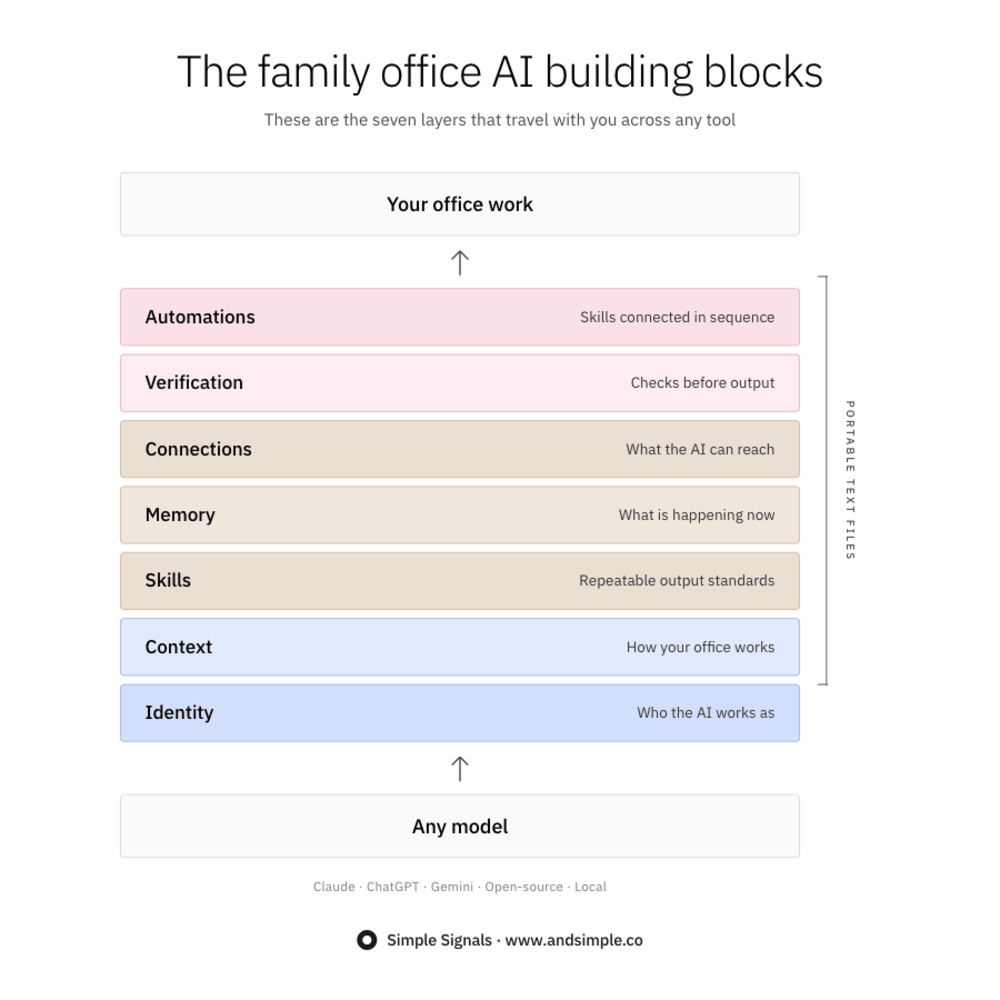
Seven layers, all portable
A practitioner framework gaining traction in agentic AI circles describes seven layers that sit between a person and any AI tool. Each layer answers a specific question the model would otherwise have to guess at. For family offices, every layer maps to a document type the office already knows.
Identity defines who the AI is working as and who it is working for. A system prompt that establishes the role, the organisation, the communication style, and the boundaries. Think of it as the AI equivalent of a governance charter: the foundational document that says who we are and how we operate.
Context is the institutional knowledge the AI needs to do useful work. Investment mandate, family governance principles, reporting cadence, key relationships, standing decisions. This is policy statements such as the investment policy statement brought to life: the same standing commitments and constraints, structured so the AI can apply them. Most offices have never written this down in one place. That gap is the first one worth closing.
Skills are repeatable instruction sets attached to recurring outputs. A deal screening template. An IC brief structure. A compliance review checklist. These are the standard operating procedures the office has always needed, now written in a format the AI can execute. Each skill ensures the AI produces the same standard of output regardless of who triggers it, which is the difference between individual and institutional AI use.
AI For Family Offices
Interested in learning more about what’s actually possible with AI and the options for family offices?
Memory, connections, verification, automations
Memory is a live document that tracks what is happening now. Active projects, open questions, recent decisions, ongoing diligence. The AI reads it at the start of each session. If the office maintains board minutes or an active deal tracker, the memory file serves a similar function: a running record that keeps the AI current without re-explaining from scratch.
Connections define what the AI can reach. Calendar, email, documents, data sources, external tools. Each connection extends the AI’s ability to act rather than only advise. As the agentic supply chain develops, these connections will extend beyond the office into the systems your service providers operate.
Verification is the layer most people skip, and the one closest to the compliance review protocols the office already runs. It defines what the AI must check before presenting output: source citations, regulatory flags, tone review, factual cross-references. Without verification, you are trusting the model’s confidence. With it, you are building in the sign-off step that every serious process requires.
Automations connect skills into sequences. A new deal arrives, the screening skill runs, a summary is produced, and if it clears the filter, the IC brief skill triggers. These are the workflow procedures the office runs every week, documented in a format where the AI can run them consistently rather than waiting for someone to remember.
Why text files matter
Every layer described above is a text file. A markdown document, a set of instructions, a structured prompt. Claude, ChatGPT, Gemini, an open-source model running locally: they all read the same files. The model becomes interchangeable. The system you built around it stays.
This also means you are building an asset the office owns rather than a dependency on any single platform. The sovereign infrastructure argument applies here at the practical level. Your context, your skills, your memory, your verification rules: these belong to the office, stored on the office’s infrastructure, version-controlled and maintained like any other operational document.
The compounding return
The first agent you build will take time. You will write the identity prompt, assemble the context file, define the first few skills, set up the memory document. It might take a weekend of focused work. The second agent will take an afternoon, because most of the foundation already exists. It shares the same context, the same memory, the same verification layer. You are adding a new role and a few new skills on top of an existing base. The third takes less still.
This is the compounding dynamic that separates offices building systematically from those still treating AI as a series of individual tool decisions. Every building block you create serves every agent you build afterwards. The context file feeds the deal screener, the compliance reviewer, and the communications drafter equally. The investment in documentation pays forward across every workflow.
The tools will keep converging. Every major AI workspace is adding the same capabilities: structured context, persistent memory, reusable skills, external connections. The vendor comparison matters less with each passing quarter. What matters is whether you have built the system underneath, the one that makes any tool work for your specific office, your specific processes, and your specific standards.