


Welcome to this week’s not-so-spooky edition.
Did a friend or colleague forward this to you?
Subscribe below.
Superintelligence Meets Exams
The Securities and Exchange Commission published its fiscal 2027 examination priorities on 23 October, covering more than 34,000 registrants. Emerging technologies, named in the release as super intelligence, are added to the areas of heightened attention, alongside adviser conflicts, private funds, operational resilience, cybersecurity, customer information, tokenisation and market infrastructure.
Signal: Examiners now name emerging technologies an area of attention, so an office with a registered entity should show who approves and reviews model use.
SEC (3 minutes)
Filed And Financed
Anthropic filed a Form S-1 on 26 October to list on Nasdaq as ANT, reporting revenue of $16.3bn for the six months to 30 June against $4.6bn for 2025. The same day, Broadcom and four financial firms announced a $63bn vehicle to buy accelerators and lease them to the company.
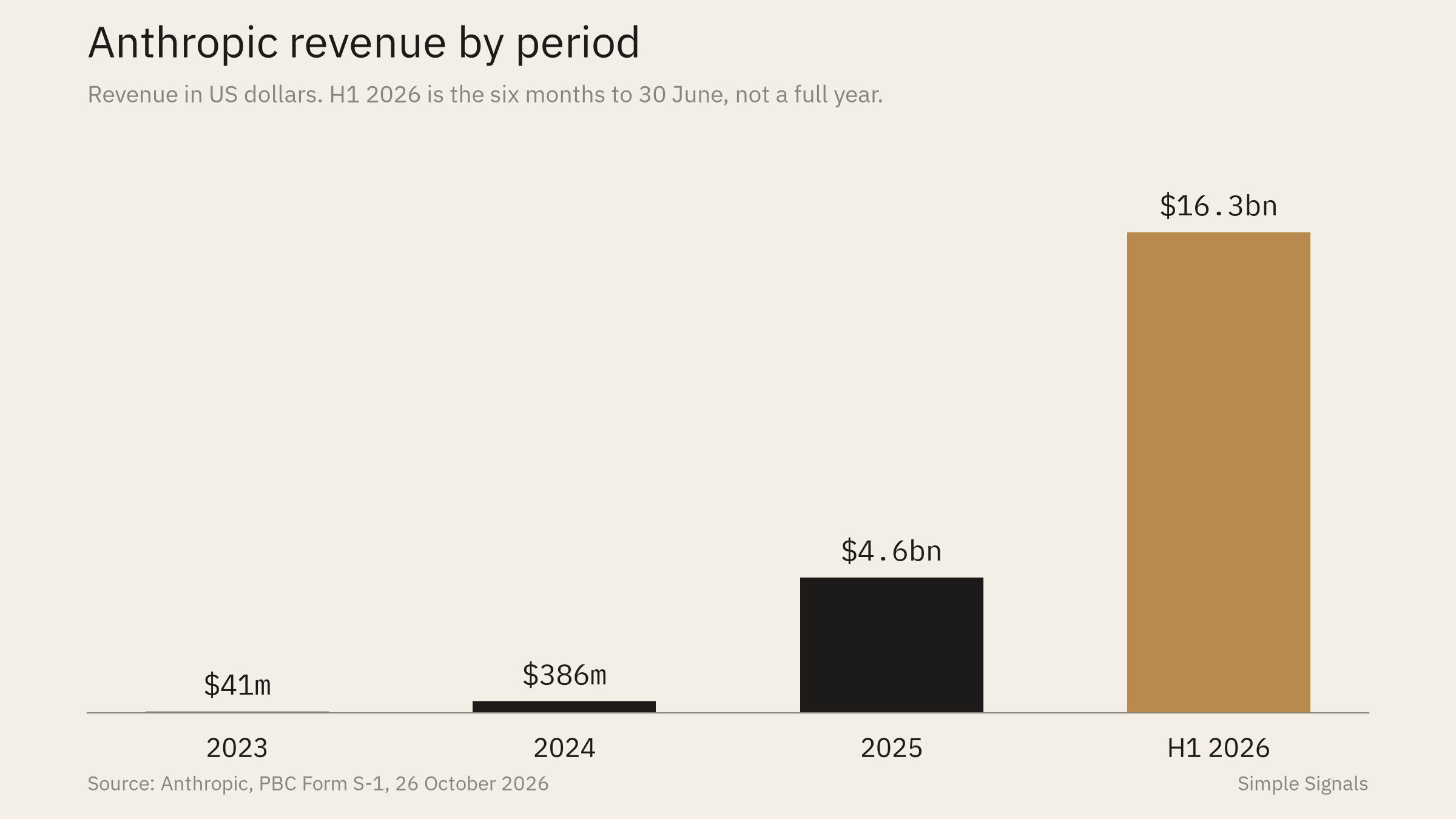
Signal: A frontier model supplier is becoming a listed security and a lease obligation, so AI exposure needs tracking in equity, credit and fund structures.
Agents Logged In Already
Axios reported on 22 October that US banks have found unauthorised third-party AI agents inside customer accounts, citing people familiar with the matter. The agents typically sign in with the customer’s credentials, which breaches most banks’ terms. Morgan Stanley has begun blocking them; its spokesperson said it has not seen rogue agents on its platforms.
Signal: An agent using a family member’s own login still breaks the bank’s terms, so account access rules should name which tools may sign in.
Axios (3 minutes)
Clients Arrive Pre-Answered
Pacific Life surveyed 113 financial professionals advising affluent clients around its September symposium, reported by InvestmentNews on 28 October. Forty-three per cent of the advisers said clients use AI to validate or challenge recommendations, and 21 per cent said clients bring inaccurate or misleading AI-generated information into conversations.
Signal: Families are checking advice against a model before the meeting, so an office should decide how it answers an AI-sourced challenge on the record.
InvestmentNews (3 minutes)
Custody Includes The Model
Schwab made Claude for Financial Advisors available inside Schwab Advisor Center to registered investment advisers that custody with it, announced at its Impact conference on 28 October. WealthManagement.com reports a 20-seat minimum on the enterprise licence and a 4,800 dollar credit for firms signing by 30 November. Schwab serves more than 17,000 independent advisers.
Signal: The custodian is now a route to the model, so an office should ask whose terms govern the data its adviser puts in.
WealthManagement.com (3 minutes)
Budget Becomes An Attack
Guidance from Five Eyes cyber agencies, updated on 22 October, treats AI token consumption as an operational resilience problem. It names denial-of-tokens and denial-of-wallet attacks, which exhaust allocations or inflate pay-per-use bills, and recommends tiering capacity across mission-critical, operational and productivity uses, with quota alerts at 70, 80 and 90 per cent.
Signal: AI spending can be driven up from outside, so budgets for model use need caps, alerts and a named owner like any other utility.
Canadian Centre for Cyber Security (11 minutes)
Thirty-Four Names Circulate
Modus reported on 24 October that a fundraiser at FocusGrowth Asset Management keeps a crowdsourced list of family offices that other fundraisers consider unproductive, cautionary or fake. The version Modus reviewed held 34 names with notes, and about 25 fundraisers have proposed edits, though only its keeper can change it.
Signal: An office’s reputation with fundraisers is recorded somewhere it cannot see, so how it handles inbound pitches is worth a written rule.
Modus (8 minutes)
From the rooms
This week the Simple team hosted 50 family offices in NYC and CPH. Over lunch in Copenhagen it was clear, in the AI era people would love to spend some more time together in person. Next week, the same in London.
The Last Word
“For every AI-influenced decision, we need a named human who is answerable.”
Shirin Hamid, Chief Information Officer of the International Monetary Fund, in the Central Bank of Sri Lanka’s 76th Anniversary Oration, Colombo, 23 October 2026
Hamid runs technology at the IMF rather than policy, and she was speaking at a central bank’s anniversary, in a lecture titled The Intelligent Central Bank: Building Trust in the Age of AI. Her related line in the same address was that the intelligent central bank is not the bank with the most AI, it is the bank whose AI can be trusted. Her test is easy to apply: for every decision a model touched, one person’s name is on it.
Want To Work Together?
Hi, I’m Francois. I have been tracking how family offices actually run for over a decade, and at Simple we openly publish what we learn: the research, the frameworks, the vendor landscape, what worked and what quietly did not. This newsletter is part of that.
The rest of the time we help offices put it into practice, from strategy and governance to operating design and technology, across Europe and the Americas, and anywhere a principal invites us to a meeting room with snacks, coffee and a whiteboard.
If you are working out what any of this means for your own setup, a conversation costs nothing. Schedule a call with me.
Share Simple Signals
The Sunday search for signal & AI in the family office industry.
The 43% stat is the real story. Clients now walk in with a second opinion in their pocket. That's no threat to a good advisor. It's a threat to one who can't explain the why behind the advice.